



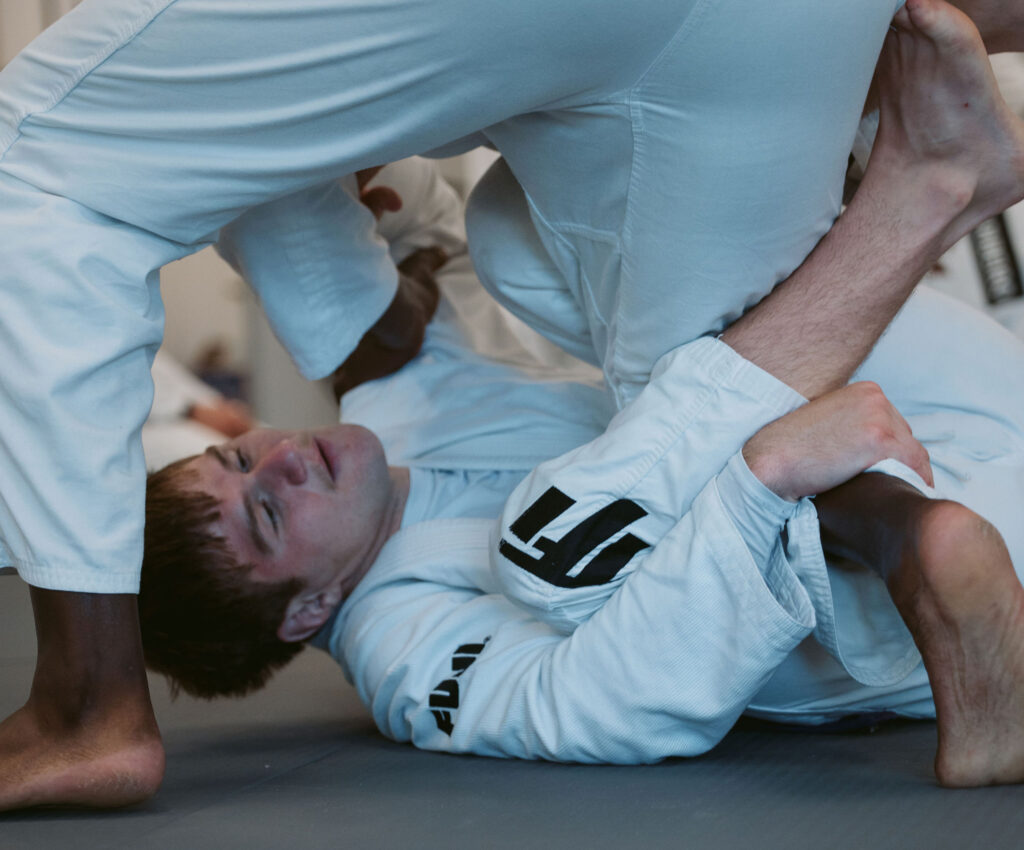
Whether you’re new to jiu jitsu or supporting a child who just enrolled, understanding the core positions of Brazilian jiu jitsu can make training feel much more approachable. In Lake Travis, students of all ages learn these foundational positions from day one, because they form the roadmap for both safety and success on the mats.
Jiu jitsu is built around control before submission. That means every sweep, escape, or finish relies on understanding the position you’re in — and the position you want to move toward. Below is a beginner-friendly breakdown of the classic positions that matter most, and why they are so foundational to progress.
Closed Guard — The First “Home Base” for New Students
Closed guard is often the first position students learn because it teaches essential balance, connection, and control. In this position, you’re on your back with your legs wrapped around your partner’s waist, keeping them close.
Closed guard helps beginners understand:
- how to control another person safely
- how to use the legs for leverage
- how to break posture
- how to set up sweeps and submissions
This position is especially important because it shows students that being on bottom does not mean losing. In fact, many of jiu jitsu’s most effective attacks — like arm locks and collar chokes — come from closed guard.
Open Guard — Learning Flexibility, Distance, and Timing
Once beginners feel comfortable in closed guard, they begin experimenting with open guard. Here, your legs are no longer locked, and you control your opponent through hooks, frames, foot placement, and grips.
Open guard helps students develop:
- movement and agility
- distance management
- transitions into attacks
- the ability to create angles
For Lake Travis students, open guard often becomes a fun challenge, because it encourages creativity and problem-solving — two essential skills for long-term growth in jiu jitsu.
Side Control — A Position of Control and Pressure
Side control is one of the most dominant positions in the art and a major goal after passing someone’s guard. In this position, you are chest-to-chest with your partner, controlling their hips, head, and shoulders.
Side control teaches beginners:
- how to apply pressure safely
- how to maintain top control
- how to isolate limbs
- how to move toward submissions
From here, students learn transitions into mount, back control, or submissions like kimuras, Americanas, or chokes.
It’s a position that builds confidence because it teaches you how to stay balanced and stable even when an opponent is trying to escape.
Mount — Dominance, Control, and Opportunity
Mount is one of the strongest positions in jiu jitsu. Sitting on top of your partner’s torso allows you to apply pressure, maintain control, and set up a variety of submissions.
From mount, students learn:
- how to stabilize their base
- how to control their opponent’s hips
- how to apply weight effectively
- how to execute arm locks and chokes
Mount also teaches beginners how to stay calm in both top and bottom scenarios. Being mounted can feel uncomfortable at first, but learning how to escape develops emotional resilience and technical awareness — two major benefits for Lake Travis students.
Back Control — The Most Powerful Position in Jiu Jitsu
Back control is widely considered the most dominant position in Brazilian jiu jitsu. With both hooks in and control over the upper body, the attacker has significant leverage while staying relatively safe from counters.
From back control, students work toward submissions such as:
- rear naked choke
- bow-and-arrow choke
- collar chokes
This position helps beginners learn how to coordinate upper- and lower-body control, maintain balance, and finish submissions with precision.
Submissions — The Final Step After Position is Earned
Beginners often focus on submissions first because they look exciting — but jiu jitsu teaches that submission only works after good positioning.
Some classic submissions beginners learn include:
- armbar
- triangle
- collar choke
- Americana
- kimura
- rear naked choke
These techniques reinforce the principle:
Position → Control → Submission
Once students understand this sequence, their entire jiu jitsu experience becomes smoother and more strategic.
How Lake Travis Students Put It All Together
At Six Blades Lake Travis, the goal is not just to teach techniques — but to help students understand why they work. By learning the classic positions in the correct order, new students build confidence, improve safety, and develop strong fundamentals.
With each class, beginners learn how to:
- stay calm under pressure
- transition smoothly between positions
- think one step ahead
- use technique instead of strength
- enjoy the process of learning
Understanding these key positions creates a solid foundation that supports every sweep, escape, guard pass, and submission that comes later.